

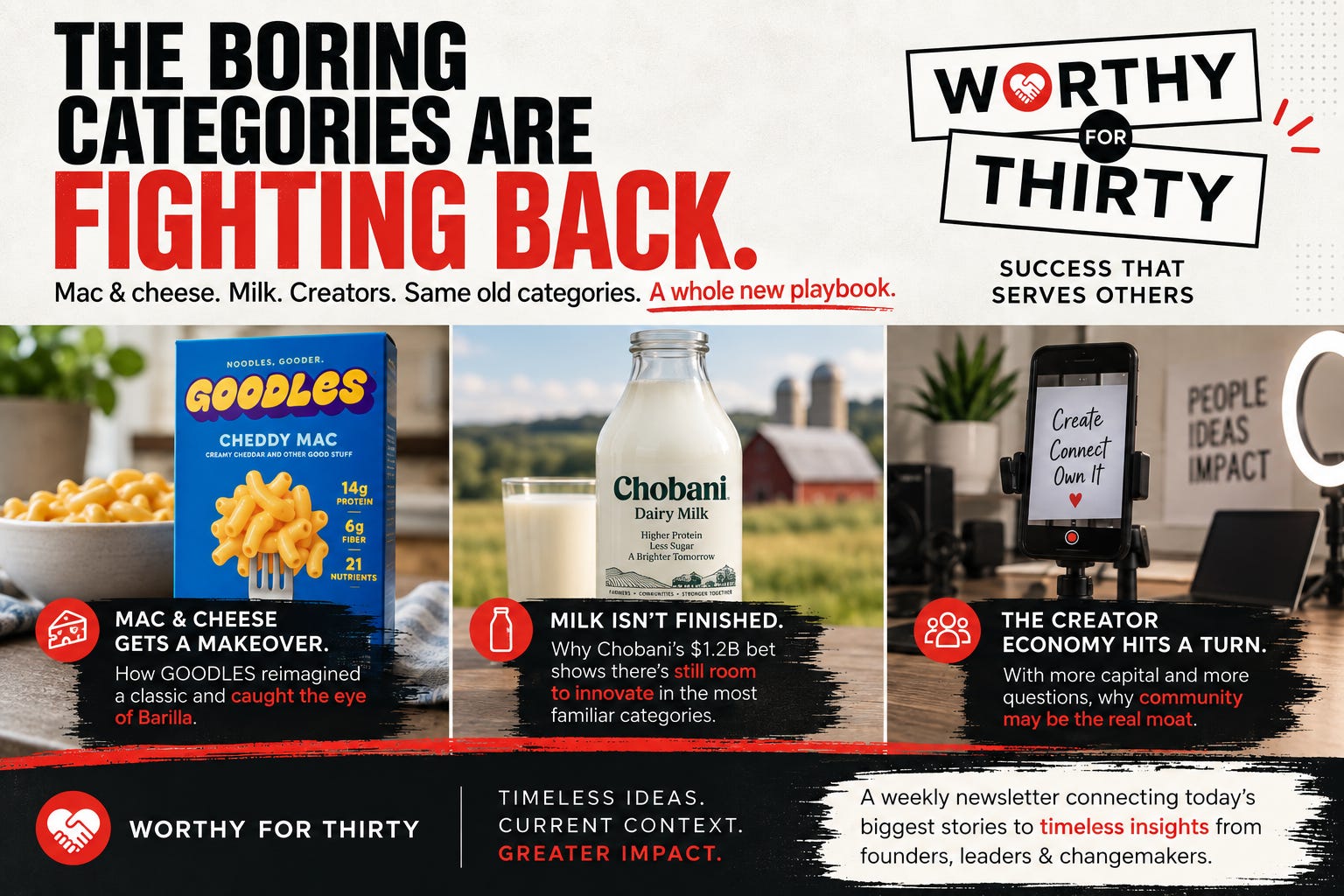
Mac & cheese gets acquired. Milk gets a $1.2 billion makeover. And the creator economy is being compelled to answer an uncomfortable question.
Last week, I wrote about protecting the principle while experimenting with the delivery.
This week, something different caught my attention: some of the biggest opportunities are hiding in plain sight.
Mac & cheese. Milk. Online creators.
None are new. All three are being retinkered.
And three conversations from the Worthy for Thirty archive suddenly feel particularly relevant. Stick with me here.
🧀 MAC & CHEESE JUST DELIVERED A MASTERCLASS IN DISRUPTION
Barilla is acquiring GOODLES, the better-for-you mac & cheese company that launched in 2021.
The price wasn’t disclosed.
The numbers tell an incredible story.
GOODLES grew from 0.8% to 7.8% of U.S. shelf-stable mac & cheese spending in just three years. Even more interesting: the company says 80% of its sales come from consumers who previously didn’t shop the category or are now buying more of it. GOODLES will continue operating independently, with CEO Jen Zeszut and all 73 employees staying on. (The Wall Street Journal)
In other words, GOODLES didn’t just steal customers from the competition.
It made an old category interesting to new ones.
And weirdly enough, that sent me back to popcorn.
💡 THE WORTHY IDEA
When I sat down with Tom Leigh, co-founder of Tommy Popcorn, we discussed entering one of the oldest, most commoditized snack categories around.
Tommy’s approach wasn’t:
How do we make another popcorn?
It was closer to:
Where is the whitespace everyone else has stopped looking for?
The company examined search behavior to discover flavors consumers wanted but couldn’t easily buy. Then it layered those insights with unconventional flavors, experiential marketing and an intentionally mysterious fictional founder named Tommy. (Worthy For Thirty)
Tom’s lesson was that data can tell you where to play, but storytelling gives people a reason to care once you arrive.
GOODLES is an apt parallel.
It didn’t birth mac and cheese.
It reconsidered who mac & cheese could be for, improved the nutritional proposition and ensconced in a brand that looks nothing like the category incumbents.
Barilla certainly noticed.
Why it matters now → Founders love talking about creating new categories. Sometimes the bigger opportunity is reinvigorating an old category everyone else assumes has already been figured out.
Don’t ask, “What hasn’t been invented?”
Ask: “What hasn’t been reimagined?”
🎧 Revisit my conversation with Tom Leigh
How a Fake Character Is Building a Very Real Brand — February 4, 2026
🥛 CHOBANI IS BETTING $1.2 BILLION THAT MILK ISN’T FINISHED
Speaking of old categories...
Milk.
Chobani announced a $1.2 billion investment in Pennsylvania this week to establish its first dairy-product manufacturing operation in the state.
At full scale, the facility is expected to process more than 3 billion pounds of Pennsylvania milk annually, roughly 30% of the Commonwealth’s current milk production, and create more than 900 jobs. Chobani is also working on traditional dairy milk with higher protein and less sugar. (Pennsylvania Government)
Think about that for a bit.
We’re living through an era of oat milk, almond milk, functional beverages, protein shakes and seemingly endless beverage innovation.
And Chobani is putting $1.2 billion behind...
cow’s milk.
That brought me back to Sam Stewart of Mad Hippie.
💡 THE WORTHY IDEA
Mad Hippie didn’t begin with a trend report saying the world needed another skincare company.
Sam and his wife Dana had a problem.
Living in Nicaragua and surfing frequently, they began to realize what all that sun exposure was doing to their skin.
They got curious.
Then they iterated.
A lot.
Sam told me the early products went through roughly 50 versions. The company first thought surfers would be its primary consumer. They weren’t. So instead of abandoning the underlying problem, Mad Hippie changed the audience and kept refining the solution. (Worthy For Thirty)
That’s the distinction.
Being committed to the problem doesn’t require being committed to your first solution.
Chobani’s bet on milk feels similar.
Consumers haven’t suddenly stopped caring about nutrition, protein or convenience.
The product delivering those benefits can change.
Why it matters now → Innovation doesn’t always require teaching consumers a completely new behavior. Sometimes you take something incredibly familiar and rebuild it around what consumers care about now.
Mad Hippie did it with skincare.
Chobani thinks it can do it with milk.
And $1.2 billion says they’re pretty serious about finding out.
🎧 Revisit my conversation with Sam Stewart
How Sam Stewart and Mad Hippie Built a Beauty Brand With Purpose, Patience, and Persistence — June 10, 2026
📱 THE CREATOR ECONOMY MAY BE APPROACHING ITS “NOW WHAT?” MOMENT
Creators became media companies.
Then brands reallocated billions of dollars in their media budget to fund them.
Now comes the difficult part:
Is the math, mathing?
Digiday reported this week that creator marketing may be approaching an economic correction, raising questions about whether influencer economics can sustain their current trajectory. At the same time, creator-focused companies continue attracting capital: CreatorFi announced a $45 million raise this week aimed at financing independent media. (Digiday)
Those two seemingly contradictory headlines sitting next to each other:
Money is pouring in.
Skepticism is increasing.
Which sent me back to one of the people who helped build the creator economy before got that label.
Elisa Camahort Page.
💡 THE WORTHY IDEA
Elisa co-founded BlogHer around a clear mission: create opportunities for community, education, exposure and economic empowerment for female bloggers.
When we spoke, her advice wasn’t “get bigger.”
It was:
Build for the people you serve, not for abstract scale.
And she was equally adamant about monetization: mission has to function as an operating system. It should influence partnerships, hiring, pricing and product decisions, not sit in a paragraph on the About page. (Worthy For Thirty)
That feels especially relevant now.
The creator economy spent years optimizing for:
followers → impressions → reach → sponsorships.
But sustainable businesses eventually have to answer harder questions.
Who are we actually serving?
What value are we creating and extracting?
Would this community still notice or care if the algorithm stopped helping us tomorrow?
Why it matters now → Distribution can make you visible. Community can make you durable.
The next phase of the creator economy may belong less to the people who build the largest audiences, and more to the ones who establish the strongest relationships with them.
🎧 Revisit my conversation with Elisa Camahort Page
Doing Good Without Losing the Plot — June 3, 2026
🚨 WORTHY RADAR
A few alumni worth watching this week.
Bill Shufelt → Athletic Brewing
Athletic’s relationship with endurance sports continues to get stronger. IRONMAN published the story behind Personal Record, its collaboration with Athletic Brewing, a non-alcoholic beer developed around post-race celebrations. (Ironman)
The review from my conversation with Athletic’s co-founder, Bill becomes more compelling: the opportunity wasn’t simply making better NA beer. It was making alcohol-free beer feel completely normal in places where beer already belonged. (Worthy For Thirty)
Luke Mickelson → Sleep in Heavenly Peace
Sleep in Heavenly Peace’s decentralized model is showing up across the country ahead of its September bed-building efforts. Lowe’s volunteers in Wilmington are preparing to build 125 beds for local children, while SHP groups in Oregon and elsewhere are organizing additional community builds. (WWAYTV3)
One bed becomes a chapter. A chapter becomes a network. A network becomes a movement.
🧠 ONE IDEA TO STEAL
Mac & cheese.
Milk.
Popcorn.
Skincare.
Creators.
This week’s stories reminded me that innovation has a branding problem.
We tend to associate it with inventing something nobody has ever seen before.
But sometimes innovation looks like something much less glamorous:
Look at something everyone thinks they understand and ask a better question.
GOODLES asked what mac & cheese could evolve to.
Chobani is asking whether milk can resonate with a new generation of protein-conscious consumers.
Tom Leigh looked at popcorn and saw unused storytelling territory.
Sam Stewart kept refining his brand’s skincare products until the market answered.
Elisa Camahort Page helped evaluate and reevaluate what an online audience could become when you treated it like a community.
You don’t always need a new category.
Sometimes you need a new way of seeing the old one.
Until next week,
Eric
Worthy for Thirty
Doing good while doing well shouldn’t be mutually exclusive.
P.S. 100+ conversations are now sitting in the show’s archive.
The best part isn’t figuring out which one is newest.
It’s figuring out which one the world just made relevant again.
We feel like we’re doing the same for Epsom salt.