

I hope everyone had a great week — I released my episode with NYT bestselling author Eric Ries and my guest co-host, also a NYT bestselling author, Kass Lazerow. We discussed how to protect a company’s mission despite what the financials may tell us.
We spend a ton of time debating outcomes: valuations, prices, hiring numbers, growth. This week’s headlines allude to a more pragmatic question: Who created the system that produced those outcomes?
From Anthropic’s atypical IPO governance to McDonald’s AI-assisted pricing to new disability-employment infrastructure, three conversations from the Worthy for Thirty archive provide the same lesson: values become reinforced when they’re the basis for how decisions actually get made.
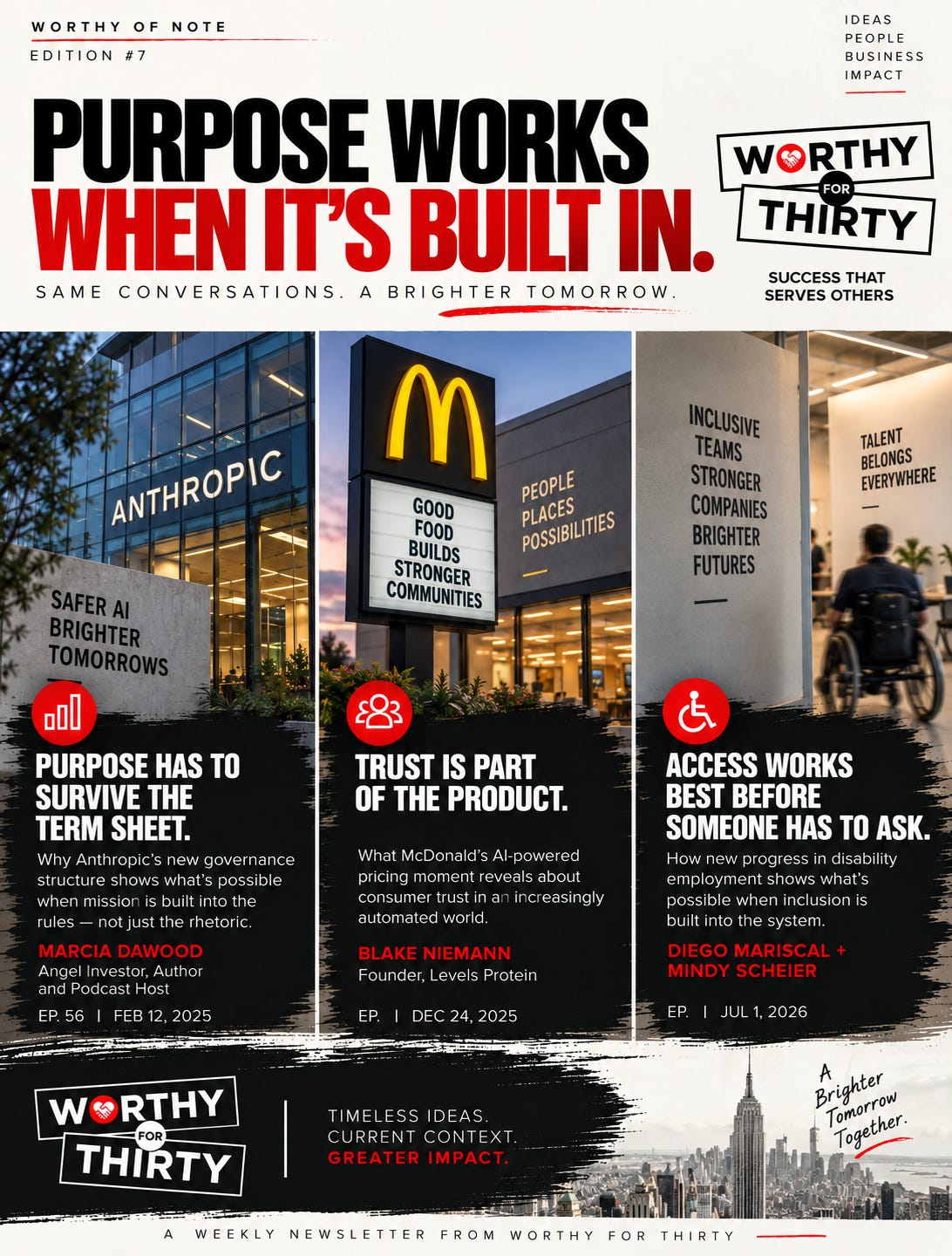
💰 MARCIA DAWOOD: PURPOSE HAS TO SURVIVE THE TERM SHEET
Marcia Dawood — “Ep. 56: Marcia Dawood, Angel Investor, Author and Podcast Host” — February 12, 2025
When Marcia came on the show, she challenged one of the most persistent assumptions in business: that investors eventually need to decide between impact and returns. Her larger argument was that capital is a means to an end. Used intentionally, it can create financial value while funding innovation, broadening access to entrepreneurship and supporting companies solving meaningful problems. Worthy For Thirty
Now consider Anthropic. In IPO disclosures reported September 29, the AI company revealed a new Founder LLC structure that will give its seven co-founders 50.1% of voting control while Anthropic remains a public-benefit corporation. The structure is intended to help leadership protect its stated mission of developing AI responsibly, even when those choices could conflict with shareholders’ financial interests. Reuters
That’s a fascinating real-life test of Marcia’s thesis. Purpose and profit are easy to pair when they point in the same direction; the harder question is what happens when they don’t. Anthropic is preempting the answer to that question before public-market pressure arrives by putting mission directly into governance.
The Worthy idea: If purpose disappears the moment shareholders disagree, it was never much of a system. Governance is where values get teeth. Also, listen to my conversation with Eric Ries. We discuss this fact.
🍔 BLAKE NIEMANN: TRUST IS A PRODUCT INGREDIENT
Blake Niemann — “Build for the Consumer. Everything Else Is Noise” — December 24, 2025
Blake’s Levels Protein playbook was refreshingly no-frills: be consumer obsessed, remove friction, and assume consumers are smarter than brands sometimes give them credit for. He explained transparency not as marketing language but as an operational discipline, from ingredients and packaging to tiny details like a clean-peel canister seal, and argued that innovation only matters when it solves something consumers actually want. Worthy For Thirty
That perspective feels particularly relevant after Reuters reported on September 29 that McDonald’s is increasingly using machine-learning tools to suggest menu prices across its nearly 14,000 U.S. restaurants. The system sifts through transaction data and estimates what customers may be willing to pay at individual locations; McDonald’s says franchisees still have the ability to set their own prices, although Reuters found that some operators felt pressure to follow the recommendations. Reuters
There’s nothing inherently anti-consumer about using better data to price a product. But there is a brand question hiding in plain sight: Does the customer understand the rules of the relationship? An algorithm can make a transaction more precise while simultaneously making the experience feel less sincere, or should I say ‘human.’
Blake’s lesson isn’t “never optimize.” It’s that every optimization ultimately lands with a human being, and trust is part of what that person is buying.
♿ DIEGO MARISCAL + MINDY SCHEIER: ACCESS WORKS BEST BEFORE SOMEONE HAS TO ASK
Diego Mariscal + Mindy Scheier — “How Mission-Driven Founders Can Build More Inclusive Companies” — July 1, 2026
My conversation with Diego and Mindy restated accessibility from accommodation to business design. Diego spoke about how disability can actually build unusually valuable entrepreneurial muscles: adaptability, tenacity, and creative problem-solving, while Mindy made a case for involving disabled people in the product development process before something goes to market. Their point was straightforward: raise funds for access early and build it into the company’s DNA vs. waiting until someone with a disability encounters a limitation. Worthy For Thirty
On September 30, 2Gether-International and Making Space publicized results from a Truist Foundation-supported workforce-development initiative for disabled professionals. The organizations reported 70 executive-track apprenticeship placements, 17 participants moving into full-time competitive employment, six entering freelance or contract work, and a 20% increase in cohort confidence around requesting accommodations and self-advocacy. InvestorsHub
The same idea is appearing at a policy level abroad. Singapore unveiled new measures on October 4 aimed at raising employment among people with disabilities from 34.7% to 40% by 2030, including a dedicated Employment Support Office, expanded training and work exposure, job-redesign support for employers and broader pathways into sectors including technology. People Matters
Both developments move beyond telling companies to “be more inclusive.” They start with an outcome and work backwards to build pathways, incentives, training and infrastructure.
The Worthy idea: You don’t unlock overlooked talent by asking people to work within the existing system. You redesign the system so their talent can be captured.
🚨 GUEST RADAR
Eliza Blank / The Farmlink Project: On October 1, The Farmlink Project joined the Zero Food Waste Coalition’s Steering Committee, alongside the U.S. Composting Council, the coalition’s first steering-committee expansion since its founding. The move gives The Farmlink Project a larger role in shaping federal, state, and local food-waste policy using its experience connecting surplus farm food with communities that need it. Waste360
Phil Schermer / Project Healthy Minds: Project Healthy Minds is heading into a major week: its annual World Mental Health Day Gala takes place October 8 at Spring Studios in New York, with fashion designer Naeem Khan serving as artistic curator; WWD spotlighted the collaboration today. The organization’s free World Mental Health Day Festival follows October 10. Women’s Wear Daily
ONE IDEA TO TAKE WITH YOU THIS WEEK
Markets tend to reward the result. Leaders have to design the steps needed to get there.
Governance settles the outcome when money and mission collide. Transparency determines whether optimization strengthens or erodes consumer trust. Infrastructure decides whether inclusion becomes real or stays trapped on a piece of paper.
The strongest organizations don’t just state what they value.
They decide where those values live when the tension arrives.