

There’s still time to support Elissa Kalver and WeGotThis.org’s ‘Be Like Brittney’ campaign, which is providing $500/day to one deserving metastatic breast cancer thriver in October. No strings attached; just delivering joy. The campaign’s $50K goal is in sight — donate and/or nominate a thriver.
On to the weekly business at hand.
The most interesting business shifts seldom show up all at once. They start on the periphery, an overlooked consumer behavior, an access problem, an inefficient system, and eventually the rest of the market catches up.
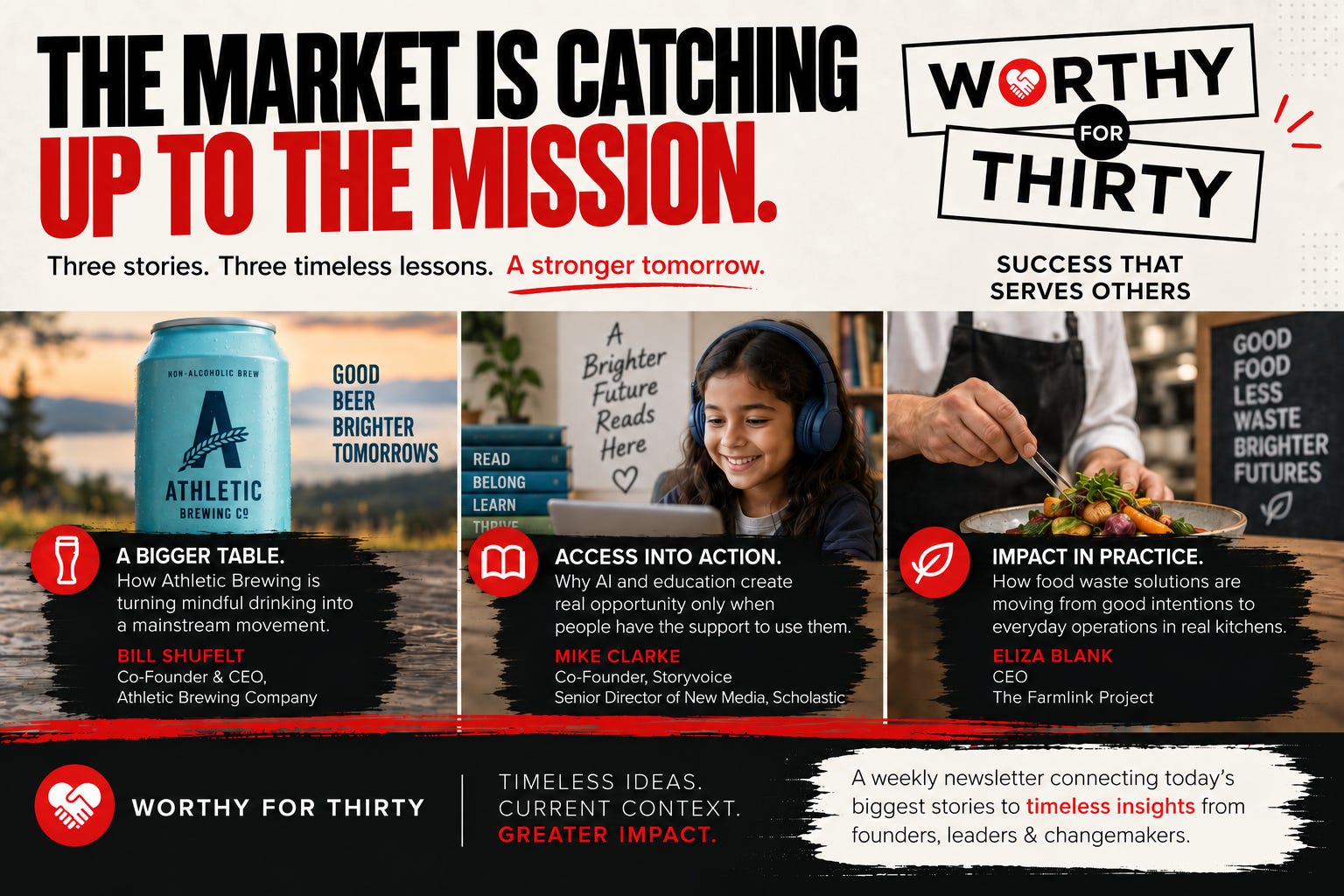
This week, three conversations from the Worthy for Thirty archive feel less like old interviews and more like a reflection of what’s happening in our current climate: nonalcoholic beer becoming mainstream, AI literacy becoming infrastructure, and food waste moving from a PowerPoint slide bullet into the kitchen itself.
🍺 BILL SHUFELT: LAY THE GROUNDWORK FOR THE EVENTUAL SHIFT
Bill Shufelt — “Ep. 51: Bill Shufelt, Co-Founder & CEO, Athletic Brewing Company” — November 13, 2024
Revisit the episode
When Bill came on the show, one of the most useful ideas was bigger than nonalcoholic beer. After realizing how much better he felt during a 30-day break from alcohol, he recognized that consumers shouldn’t have to decide between partaking in the social ritual vs. pursuing their wellness goals. It shouldn’t be an ‘either or’ decision. Athletic bet that if you made the product genuinely good, nonalcoholic beer didn’t need to live in a penalty box for people who “couldn’t drink”—it could become a choice people actively pursued. worthyforthirty.com
On September 22, Reuters reported that AB InBev is adapting its portfolio to changing drinking habits and health-and-wellness demand, including more zero-alcohol offerings, smaller package sizes, and even beverages with protein or electrolytes. The company also sees nonalcoholic beer as an opportunity around casual meals and occasions where traditional beer may not fit. Reuters
That’s what category change looks like: the behavior that once seemed niche or fringe starts influencing the incumbent’s roadmap.
The Worthy idea: Don’t ask whether a new behavior is big enough today. Ask what happens if consumers no longer want to go back.
📚 MIKE CLARKE: ACCESS DOESN’T AUTOMATICALLY MEAN ADOPTION
Mike Clarke — “Reading is FUNdamental” / Co-Founder, Storyvoice and Senior Director of New Media at Scholastic — January 2, 2024
Revisit the episode
Mike built Storyvoice from his experience working with Syrian refugee communities in Lebanon, where he saw children struggling to access education and language resources. His team eventually moved from a one-to-one reading-buddy concept to a scalable one-to-many platform built to make shared reading free, safe, and accessible; by the time of our conversation, Storyvoice had reached more than 100,000 classrooms and families across 35 countries. worthyforthirty.com
Now replace “reading” with “AI literacy.”
On September 23, Verizon announced a $70 million AI-skills initiative pairing free training from organizations including IBM, Google, Microsoft, Anthropic, Coursera and OpenAI with local nonprofits such as Goodwill. Verizon’s own framing is instructive: access to content alone isn’t enough, so community organizations will provide coaching and hands-on support to help people actually turn courses into usable skills. Verizon
A day earlier, Zoom Cares announced another $2.75 million in AI-for-Good grants, including support for teachers, workers, refugees, and nonprofits trying to build real AI capability—not simply tool access. Zoom
Mike’s Storyvoice journey offers the same lesson: technology scales possibility; human infrastructure turns possibility into participation.
The Worthy idea: Distribution gets a tool into someone’s hands. Design, trust, and support determine whether it changes anything.
🥕 ELIZA BLANK: IMPACT GETS REAL WHEN IT ENTERS OPERATIONS
Eliza Blank — “From Founder to Safety Net: Eliza Blank on Building Impact That Holds” — January 21, 2026
Revisit the episode
My conversation with Eliza kept returning to a deceptively simple principle: reliability is impact. At The Farmlink Project, that means building the logistics and partnerships necessary to move surplus food from farms to communities facing food insecurity; Farmlink helped distribute 150 million pounds of surplus produce in 2025. Eliza’s insight was essentially to optimize before expanding; to make the system dependable enough that people can count on it. worthyforthirty.com
That came to mind watching what begins in New York today.
Mill’s third annual Make Food Not Waste Restaurant Week, running September 28 through October 4, brings together Michelin-recognized restaurants, James Beard Award winners and neighborhood operators with an explicit commitment to zero-waste cooking. Participating kitchens are using Mill to rethink how ingredients and scraps move through the back of house rather than treating food waste solely as a consumer-awareness campaign. GlobeNewswire
That distinction matters. Sustainability becomes difficult to abandon when it stops being a message and starts becoming the system.
The Worthy idea: The strongest mission-driven businesses don’t just communicate their values. They operationalize them.
A quick note from one of Worthy for Thirty’s newest sponsors, Gustus Vitae. Long before they became a sponsor, I had the opportunity to sit down with co-founder Frankie Scanlon to talk about how Gustus Vitae has grown from its farmers market roots into a brand built around quality, community and making cooking more accessible and fun. That conversation, and the way Frankie and his team think about building a business with purpose, made it a no-brainer to support the show. Gustus Vitae crafts small-batch, all-natural seasonings, sea salts and artisan cane sugars designed to make everyday food better. Click here to shop Gustus Vitae and get 15% off your order + free shipping—and support a brand that supports Worthy for Thirty.
🚨 GUEST RADAR
MJ Gottlieb / Loosid: On September 23, Loosid announced an expansion of its recovery platform aimed at connecting formal treatment with everyday sobriety, including tools for treatment providers and its AI-powered Sobriety & Addiction Mentor, SAM. The move pushes Loosid further from a consumer community app toward infrastructure for ongoing recovery support. openPR.com
Bill Shufelt / Athletic Brewing: Athletic and Graza announced Cold Off The Press on September 23, a limited-release nonalcoholic pilsner made using Graza extra-virgin olive oil. Beyond the novelty, it’s another example of Athletic treating NA beer as a platform for product experimentation rather than merely an alcohol substitute. Brewbound
ONE IDEA TO TAKE WITH YOU
Non-alcoholic beer. AI education. Food waste.
The industries are different, but the pattern is the same:
Yesterday’s edge case can become tomorrow’s OS.
The leaders worth following are the ones who see consumer behavior change before everyone else does and builds the product, infrastructure or system that makes that new behavior easier.
By the time the market agrees, they’ve already been ahead.