

Three very different stories this week landed on the same lesson: good intentions are only the start. AI needs regulation. Philanthropy needs systems in place. Inclusion works best when it changes the product itself, not simply the messaging around it.
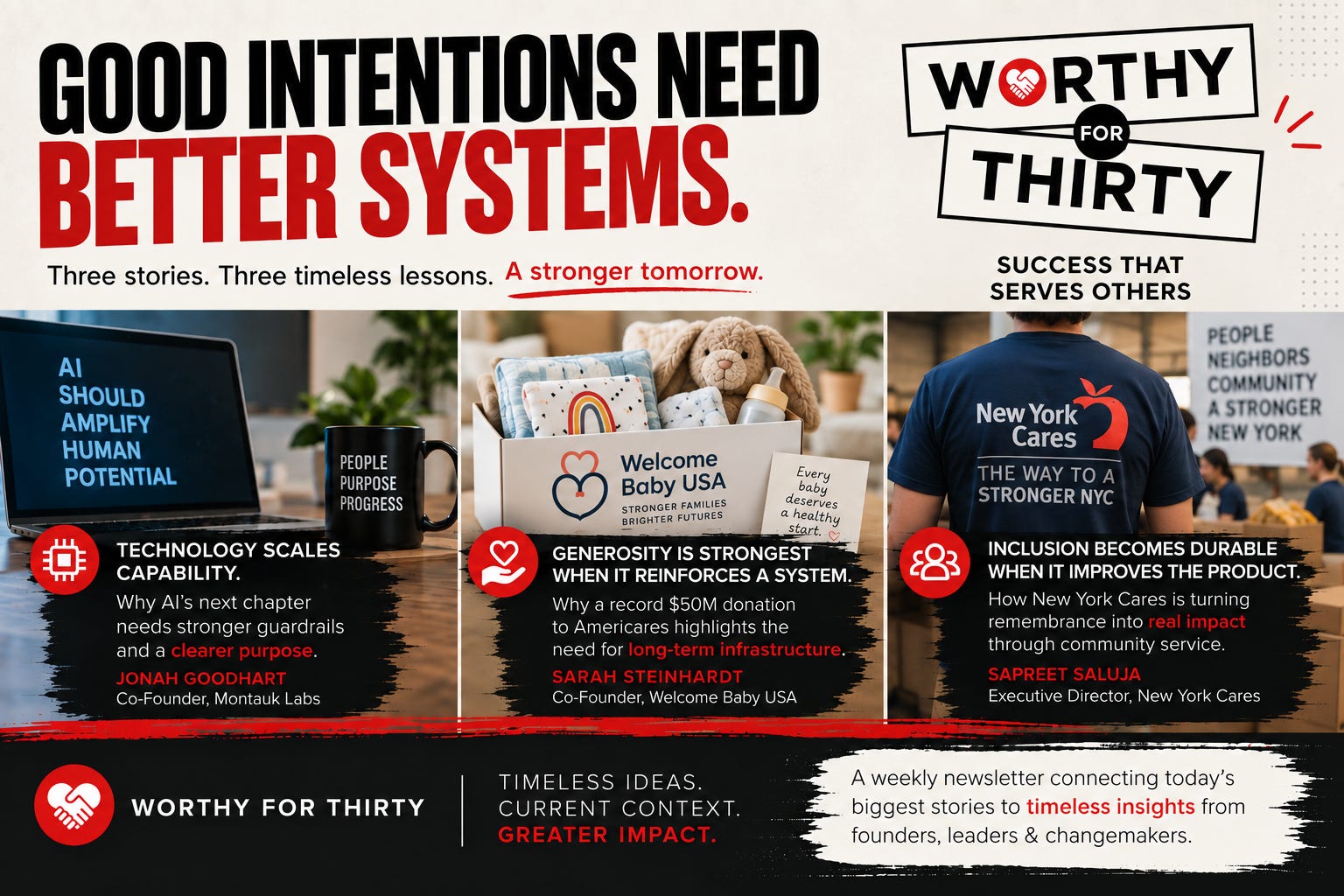
Looking through the Worthy for Thirty archive, three conversations rise to the top because each guest was talking about the same thing: how values become more enduring when you build them into the system.
🤖 JONAH GOODHART: “TECH FOR GOOD” NEEDS AN OPERATING MODEL
Jonah Goodhart — Ep. 24: Jonah Goodhart, Co-Founder, Montauk Labs — May 4, 2023
Revisit the episode
When Jonah came on the show in 2023, actually in person at P&T Knitware in NYC, he made an important callout: technology alone isn’t inherently positive; it needs human intervention to shape it. He and his brother Noah founded Montauk Labs around the concept that technology could solve meaningful problems while still building sustainable businesses. In healthcare, for example, Jonah described using their background in data and analytics to improve health outcomes, not just uncovering another application for the technology because it existed. (Worthy for Thirty)
That feels particularly relevant now.
Anthropic CEO Dario Amodei called this week for AI companies to slow the advancement of frontier models enough to create stronger safeguards, proposing independent evaluators, coordination between leading AI companies, and greater international cooperation. Two days later, Microsoft released its own draft AI “code of conduct,” including requirements that systems remain correctable, shut-downable, and under human control. (Reuters)
We’ve quickly realized AI can do extraordinary things. The question now is whether the structures surrounding it can mature as quickly as the capabilities do.
Jonah’s conversation offers a useful perspective and guide: don’t start with what the technology can do. Start with the outcome you actually want it to create.
The Worthy idea: Technology scales capability. Leadership has to scale responsibility with it.
👶 SARAH STEINHARDT: PHILANTHROPY CAN FILL A GAP. IT CAN’T BE THE WHOLE SYSTEM.
Sarah Steinhardt — Ep. 37: Sarah Steinhardt, Co-Founder, Welcome Baby USA — December 5, 2023
Revisit the episode
Sarah co-founded Welcome Baby USA around an incredibly tangible gift for indigent mothers: boxes with diapers, wipes, feeding essentials, clothing, and other basics newborns need during the first four weeks of their lives. But what stuck with me from our conversation was that Sarah didn’t devise charity as the end-all, be-all solution. She talked about hospital and clinic partnerships, learning from social workers and pediatricians, and ultimately the need for systemic government support for essential baby-care resources. (Worthy for Thirty)
This week, Americares received the largest donation in its history: $50 million from an anonymous Connecticut family as U.S. government cuts have uprooted programs ranging from maternal and child health and HIV treatment to other global-health services. Half of the gift will support Americares’ effort to reach 100 million people with healthcare by 2030; the other half will strengthen its endowment. (AP News)
It’s an incredible act of generosity.
It’s also a reminder of something uneasy: when essential services depend on extraordinary acts of generosity, the underlying system may be tenuous.
That’s what made Sarah’s perspective so useful. Donations matter enormously. Corporate partnerships matter. Volunteers matter. But mission-driven organizations can also use their closeness to the problem to help demonstrate where temporary relief needs to become part of a permanent system. Do we look to free enterprise to create it?
The Worthy idea: Generosity is strongest when it reinforces a system, not when it is forced to become one. It’s also a question of perhaps where government dependency ends, and private businesses or nonprofit intervention starts.
♿ MINDY SCHEIER: ACCESSIBILITY IS A PRODUCT STRATEGY
Mindy Scheier — Ep. 34: Mindy Scheier, Founder & CEO, Runway of Dreams & Gamut Management — October 5, 2023
Revisit the episode
Mindy’s journey began because her son Oliver, who has a rare form of muscular dystrophy, wanted to wear jeans like his friends. She created a pair herself, and eventually turned that experience into a business and nonprofit to help mainstream brands build products for people with disabilities, understanding their needs from the start. Runway of Dreams has collaborated with brands including Tommy Hilfiger and Victoria’s Secret, while Gamut Management is the consulting arm helping companies enter the adaptive-products market from concept through launch. (Worthy for Thirty)
This week, Vogue profiled Weldun, a new luxury marketplace created around functional fashion. Founder Carly Berlin founded it after a double mastectomy (perhaps she and Elissa from WeGotThis.org should chat) made her realize how difficult it was to find clothing that accommodated changing physical needs without sacrificing style. Weldun organizes products around needs like easy on/off, healing and recovery, sensory considerations, and flexible fit, and it includes existing luxury pieces whose accessible features may never previously have been marketed that way. (Vogue)
That feels like a natural growth of Mindy’s platform.
Accessibility doesn’t have to mean building a separate, clinical product for a small audience. Designing for disability, recovery, aging, pregnancy, or limited dexterity can uncover product improvements that make something better for far more people; inclusion is the strategy.
The opportunity isn’t simply inclusion.
It’s better design.
The Worthy idea: Inclusion becomes durable when it improves the product.
🚨 GUEST RADAR
Bill Shufelt / Athletic Brewing: New England Patriots quarterback Drake Maye and Dallas Cowboys quarterback Dak Prescott have become athlete-partners and equity holders in Athletic Brewing as part of multiyear relationships tied to the brand’s new “Athletic Fits” campaign. Athletic is now available at more than 200 professional and collegiate sports, endurance and entertainment venues; a meaningful next step in its push to make nonalcoholic beer an integral part of mainstream sports culture. (CT Insider)
Monica Yunus + Camille Zamora / Sing for Hope: Twenty-five years after Sing for Hope’s roots at Juilliard, six artist-designed Sing for Hope Pianos returned to Lincoln Center’s Hearst Plaza on September 11 for public play and programming through September 20. The activation reconnects the organization with the artistic community where its founders first began mobilizing musicians around service following the 9/11 terrorist attacks on the World Trade Center and Pentagon. (Sing for Hope)
Sapreet Saluja / New York Cares: To commemorate the 25th anniversary of the 9/11 terrorist attacks, New York Cares partnered with 9/11 Day on a four-day service effort aboard the Intrepid, with more than 1,000 New York Cares volunteers supporting an effort to pack over three million meals for New Yorkers facing food insecurity. (New York Cares)
ONE IDEA TO TAKE WITH YOU
AI guardrails. Baby essentials. Adaptive clothing.
Very different problems, but the same leadership challenge:
Can the thing you say you care about survive growth?
Mission statements can inform and convey to people what you believe. Systems decide whether those beliefs are still important when the company gets bigger, the technology gets faster, or the problem gets more demanding.
Values become durable when they shift from the statement into repeatable action.
Until next week,
Eric
Worthy for Thirty — where leaders doing good while doing well tell their stories.